Popular Articles
- Equine Cushing's Disease (ECD) 19 Jan, 2024
- My horse is lame, what should I do? 16 Oct, 2023
- Tendonitis in horses 17 Oct, 2023
Blog Search
To ensure your horse's good health, it is important to understand how it functions. Although mobility is essential for good performance, nothing would be possible without an efficient respiratory system. Indeed, it is the latter that will ensure the supply of oxygen, necessary for the functioning of the whole organism, as well as the elimination of carbon dioxide.
When we talk about breathing, you probably think of your horse's lungs and nostrils, but the respiratory system is a little more complex. We'll take a look at the anatomy and function of how this works.
If your horse's respiratory system has many similarities with yours, we will see that it has some particularities linked to its adaptation for racing and effort.
If we look at the system as a whole, it is made up of three main parts:
In this article we will focus on the aerial tract, which is extremely well developed in the horse as it is very important for proper breathing.
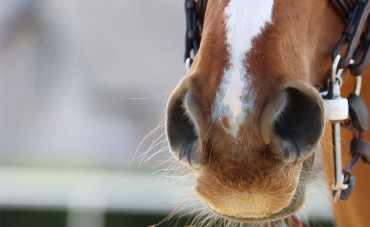
The airways begin at the level of the nostrils, which are formed by cartilage that allows inhalation and exhalation. The capacity of movement of the nostrils is very important so that they can open wide, thanks to facial muscles, and thus allow a large volume of air to circulate. Unlike humans, the horse can only breathe through the nose, which explains this "open" capacity of the nostrils.
Once in the nasal cavity, the air will come into contact with a mucous membrane that is highly vascularised and it is here that the inhaled air will be heated. It is also in this region that the sinuses and guttural pouches are found. Although the roles of these two areas are not well defined, there are important vascular and nerve structures that pass close by. Damage to either of these areas can have dramatic consequences for your horse.
Next, the air will pass through the pharynx and then through the larynx. At the entrance to the larynx, there are two elements that "circulate" between the air and the food:
The larynx is a very muscular area. It is thanks to a particular contraction of these muscles during exhalation and the activation of the vocal cords that the horse can neigh. Sometimes, certain muscles of the larynx can no longer contract correctly, causing a vocal cord to malfunction (generally on the left), which can restrict the flow of air by obstructing part of the larynx. At rest this is not a problem, but when the horse is put under stress it may have difficulty breathing and usually produces an abnormal sound.
Once past the larynx, the air goes into the trachea and then the bronchioles before ending up in the alveoli, which are "little bags" with extremely thin walls that allow gas exchanges with the blood.
As mentioned above, the oxygen contained in the incoming air goes into the bloodstream and thus supplies the whole body. The carbon dioxide (waste product of the body) will pass from the blood into the air and then be expelled to the outside via exhalation.
This summarises your horse's respiratory system. As you can see, there is a unique and fragile pathway for supplying oxygen to your horse's body. In future articles, we will offer advice on how to care for this respiratory system and discuss the main conditions that can affect it so that you can best prevent respiratory problems in your horse.
Start typing to see products you are looking for.